· Range Repair
Viking Burner Clicks but Will Not Light: A Cambridge Walkthrough
A Viking burner that sparks but will not light after a clean is usually a cap set down out of register, a blocked port or trapped moisture rather than a failed igniter. Here is the order to check it, and the point where it becomes a call.
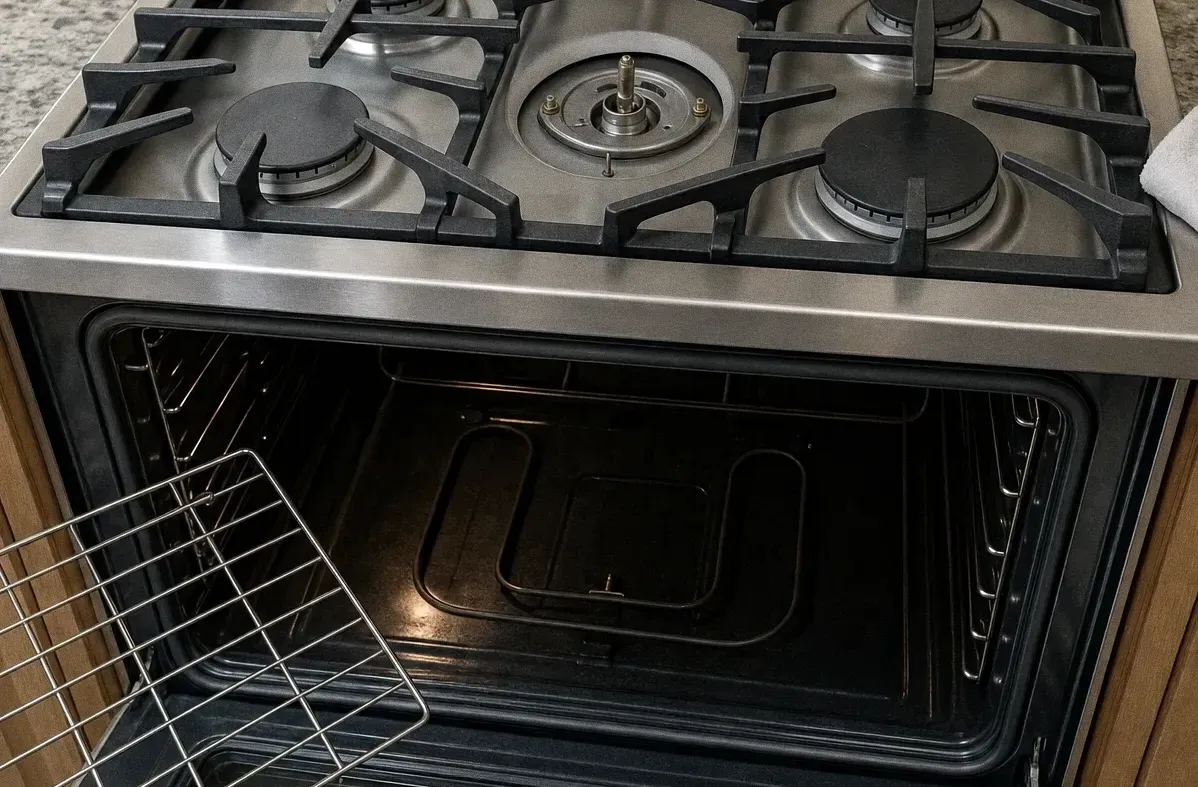
Say it happened on a Saturday. The grates went into the sink, the caps and heads were scrubbed, the whole top was wiped down and put back together before lunch, and it looked better than it had in a year. Then somebody went to make coffee and the front-left position ticked and ticked and produced nothing.
Two things need saying up front. If there is a gas smell that does not disperse when you open a window, leave the house and ring the gas utility from the street; that is not a repair call. And the ticking itself is not a symptom of ignition failure — it is the sound of the spark system working. Sound is proof of an electrical event and proof of nothing else, because fuel travels to the ports in complete silence.
The question that halves the problem
Count the burners that fail before touching a single component. If one position sparks and stays dark while the rest light normally, the fault lives on that burner: its cap, its ports, its electrode. If nothing on the top will catch, the burner has been cleared and the enquiry moves outward to the spark module, the gas supply into the building, or the earth the module works against.
Do not count the clicking. On many professional tops a single module feeds all the electrodes, which is why one knob sets the entire row ticking at once. That is how the design behaves, not a fault, and it misleads more homeowners than any other symptom on the appliance.
There is one variant that is genuinely its own fault: clicking that carries on with every knob in the off position. Park that one — it has a section of its own further down, and the answer is different.
Write down which positions fail, whether they fail cold or only once the top has been running, and what happened immediately before it started. On this topic the answer is usually the cleaning, and knowing that saves an hour of looking in the wrong direction.
Access is worth thinking about early in Cambridge. In Huron Village the kitchen is generally at the back of the house up a tight rear stair, and around Porter Square a wide top that went in during a gut renovation is not coming back out through the front door without carpentry. Anything diagnosed and repaired in place is worth real money here, which is an argument for working through the cheap checks properly rather than concluding that the appliance is finished.
The cap, the ports and the last time it was cleaned
Cleaning causes this fault in three ways, and all of them are reversible. Caps get put back a few degrees out of true. Caps get swapped between positions on a top where the sizes differ. And water gets left in places that cannot be seen from the room. Every one of those will produce a healthy spark and no flame.
The cap and the burner head are machined to sit together in one orientation, and gas leaves the head through that relationship. Set a cap down on a grain of rice, on a fragment of grate coating, or a few degrees rotated, and the flame path changes shape. The fuel goes somewhere the electrode is not, and the spark fires uselessly into clean air. On a range with four or six positions of different output, mixing two caps produces the same result on both.
Ports are the small slots around the rim. Detergent film, scouring residue and old carbonised spill all block them, and the safe tools are a soft brush, warm water and a wooden toothpick. Steel pins, needles and paperclips can widen a port or roll its edge over, and that change does not undo itself. A burner with one enlarged port never burns evenly again.
Water is the one that catches everybody. If caps and heads went through a dishwasher or a long soak, moisture is sitting inside the head and across the base of the electrode where no towel reaches, and ignition will stay suppressed until it has fully gone. There is no honest number of minutes to quote — it depends on how soaked it got and how warm the kitchen is. Give it considerably longer than seems sensible before deciding anything is broken.
Confirming the cap without guessing takes ten seconds. Lift it, set it back, and feel for it dropping into one settled position. Then look across the cooktop at eye level: caps should read as a level row. One sitting proud of its neighbours has found something underneath it.
Where the spark is supposed to jump
Turn the kitchen lights off and watch a working burner ignite, then watch the failing one. What you want is a tight, fast, blue-white snap: a short jump from the tip of the electrode across to the nearest edge of the burner head, landing in the same spot every time. That is the reference. Anything else is information.
A spark that reaches sideways for a grate, a trivet or the cooktop surface is still a spark, and the module still clicks, because nothing in the system reports where the energy ended up. It simply is not arriving where the gas is. Bent electrodes are common on tops that get cleaned enthusiastically, and they are frequently bent by the cleaning itself.
Then the ceramic. The white sleeve at the base of the electrode exists to stop the pulse escaping before the tip. Crack it — thermal shock from cold water on a hot burner does this neatly — and the energy takes the short route into the metal below. You hear clicking, you may see a faint flicker in the wrong place, and the gap stays dead. These faults are worse in damp weather and often clear up on a dry afternoon, which is exactly why they get misdiagnosed.
Carbonised residue bridging the gap behaves the same way, and responds to careful dry cleaning around the tip with nothing abrasive.
Continuous clicking with everything off
The spark module is a small high-voltage supply. A switch behind each knob tells it that a burner is being opened, and it answers by pulsing the electrodes until it is told to stop. On a shared arrangement it pulses all of them together. That is the whole job.
So a top that clicks with every knob off is a module that has not been told to stop. Either a switch is no longer opening — worn contacts, or a spill that ran down behind the knob and set — or moisture has bridged something and the module is reading a signal that nobody sent. It is a small fault with an unpleasant sound and it will not repair itself.
This is where the reader hands over. The knobs, the switches and the module sit behind the control panel of an appliance that combines high voltage with a live gas manifold, and the noise is not worth the risk of learning that geography. Kill the circuit at the breaker to stop the clicking, leave the gas shut-off in whatever state you found it, and book the visit. The service call is $95, and where an igniter or burner assembly is the answer, that work runs $290 to $650. The Range Repair page sets out what gets checked.
The symptoms that mean stop now
The gas-smell rule comes first and does not bend: a smell that will not clear means everybody leaves and the utility gets the call. After that, three symptoms mean the checks above are finished. Continuous sparking. A burner that lights several seconds late with a soft thump, which means fuel accumulated before it caught and is more urgent than a burner that never lights at all. And a burner that lights, settles and then goes out on its own.
What a technician establishes is not available from the kitchen: whether the module holds its output under load, whether gas is reaching the manifold at working pressure, and whether that switch is genuinely opening. Those are meter readings, and guessing at them costs more than measuring them.
We work through Huron Village, Porter Square and East Cambridge on this kind of call. At the head of this page you will find the number to ring and the link to book a slot. The model plate usually sits behind the kick panel, and finding it before we arrive shortens the visit.
Also asked
The burner clicks — does that mean the igniter is fine?
Not quite. It means the module fired and something at the electrode drew current. It does not mean the spark crossed the gap where the fuel actually is. A cracked ceramic sleeve or a bent electrode makes the identical sound while sending energy into the wrong metal. Darken the kitchen and look for a tight blue-white snap in one consistent spot; that is the test the noise cannot pass on your behalf.
All the burners click at once when I turn one knob. What is that?
Normal on most professional cooktops. A single spark module serves the whole top, so a request from any knob fires all the electrodes together until a flame is established. It sounds alarming and costs nothing. The thing worth attention is whether the burner you asked for lights, and whether the ticking stops once it has — or carries on with everything switched off.
Is a burner that lights after five seconds a problem?
Yes, and more of one than a burner that never lights at all. Through that pause the burner releases fuel that is not burning, so what finally catches is an accumulated pocket rather than a steady flow, which is the thump people describe. It usually traces back to a cap out of register or ports fouled near the electrode. Worth resolving before it becomes routine.